
Turning Back Time
The Facelift & Neck Lift Combination Surgery
John Park MD Plastic Surgery | Newport Beach, Irvine, Orange County, California
Is A Combo Facelift & Neck Lift The Answer?
Facelifts and neck lifts are safe and well-established procedures for cosmetic facial rejuvenation. In the hands of an experienced plastic surgeon and for the right patient, a facelift and neck lift can turn back the clock years and produce a natural result. Understanding the different techniques used in facelifts and neck lifts can be challenging for prospective patients, which is further complicated by surgeons creating names for procedures for marketing purposes. With the flood of information out there, some of which prioritizes promotion over patient education, the thought of learning about this procedure for a prospective facelift and neck lift patient may be daunting.
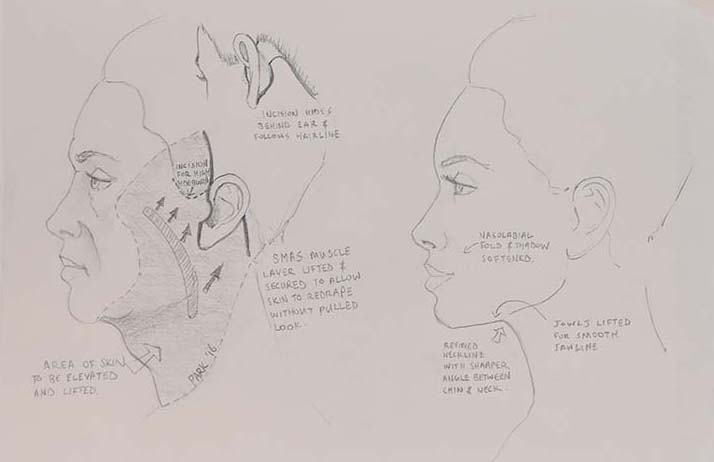
Targeted areas
Combining facelift and neck lift surgery is primarily designed to improve looseness and laxity at the neck and jowls located in the lower face. Depending on the technique, there may also be an improvement to the midface area around the cheeks. Facelift and neck lift surgery are primarily done under general anesthesia, although some surgeons prefer deep sedation.
Mapping incision points
Classically, the incision starts in the scalp at the temples, follows around the front border of the ear, known as the tragus, continues around the earlobe along the groove where the ear meets the head, and then continues either along the hairline behind the ear or into the scalp. In individuals with high sideburns, the incision may follow along the front border of the sideburn hairline. There are specific factors that determine the position and length of scars for each individual. When consulting a surgeon, prospective patients should expect the physician to spend time educating about incision design and the rationale.
Beneath the surface
This incision on either side allows elevation of the skin. Much like lifting a comforter exposes the underlying bedsheet, elevating the skin flap exposes the underlying superficial muscular aponeurotic system (SMAS). The SMAS is a fibrous and somewhat fatty membranous layer in which many of the muscles of facial expression reside. All modern facelift and neck lift techniques address laxity at the SMAS. How the SMAS layer is lifted determines the type of facelift procedure being performed. There are four type of techiniques with the most common being SMAS plication.
SMAS plication
With SMAS plication, the SMAS is lifted by suturing the SMAS to itself in a zone parallel to the nasolabial fold, halfway between the nasolabial fold and the ear, in such a way that the loose SMAS is folded in upon itself. The net effect is an elevation of the jowls and an improvement of neck laxity. The chief advantage here is that the SMAS does not need to be cut, so there is less risk of nerve injury. The primary disadvantage is that the process of suturing the SMAS by folding in the excess tissue can create irregular pleating, which needs to be addressed to prevent a secondary contour deformity from forming, visible through the skin.
SMASectomy
With SMASectomy, the strip of loose SMAS tissue that would otherwise be folded inwards upon itself in SMAS plication is excised instead. The primary advantage here is that the irregular pleating is significantly less of an issue, as the loose SMAS has been removed. However, this comes with a slight increase in the risk of nerve injury, as the surgery requires going underneath the SMAS and then cutting out a portion that is in the space where the nerves controlling facial expression reside.
Deep plane
With the deep plane face and neck lift, before excising any redundant SMAS tissue, the SMAS layer is elevated much like the skin flap was elevated. This method allows more freedom of movement of the muscle layer, which many physicians believe is superior to SMAS plication and SMASectomy. The primary disadvantage is the requirement for extensive dissection and surgery deep to the plane of the SMAS layer, where all the nerves reside. Therefore, there is a higher risk of motor nerve injury associated with the surgery. This is a technique that requires extensive experience and expertise.
Extended deep plane
Most prospective patients are familiar with the term deep plane facelift. In the traditional deep plane facelift and neck lift, the incision in the SMAS to initiate the deep plane dissection is parallel to the nasolabial fold and halfway between the ear and the nasolabial fold. With an extended deep plane face and neck lift or high SMAS deep plane facelift and neck lift, the incision to initiate the deep plane dissection is higher up on the face near the junction where the cheek meets the temple and in front of the ear down into the neck. This procedure affords even greater freedom of movement of the SMAS layer, resulting in significant improvement in the midface that surpasses what can be achieved with other techniques.
Choosing a technique
Patients with significant platysmal muscle bands in the neck may benefit from a corset platysmaplasty. Before choosing a plastic surgeon for these procedures, understanding the types of techniques available is vital. Dr Park has been performing facelifts and neck lifts in Newport Beach for over a decade. He is board-certified with the American Board of Plastic Surgery and created the above illustration to help patients better understand these procedures.